Engineering plastics have excellent comprehensive properties, such as high rigidity, low creep, high mechanical strength, good heat resistance, and good electrical insulation, making it suitable for long-term use in harsh chemical and physical environments, and can replace metals as engineering structures. Material use.
With the development of technology, the application of engineering plastics continues to expand, and has been extended to various fields such as automobiles, home appliances, aviation, medical care, sports, electronics, and construction. With the trend of lightweight cars, more and more automotive plastic parts are used.
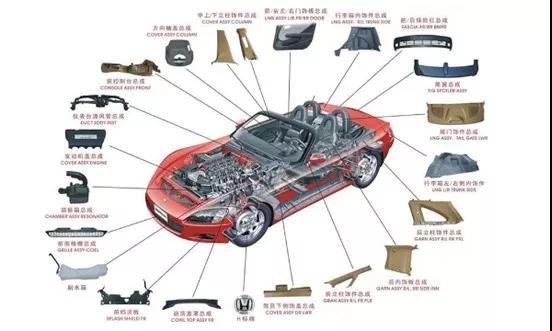
First, let everyone know about polyamide (PA), polycarbonate (PC), polyoxymethylene (POM), polymethacrylate (PMMA), polyurethane (PU), polyester (PBT/PET), polyphenylene ether ( PPO) How are these engineering plastics used in the automotive field?
PA material
Polyamide, commonly known as nylon, has many types of PA in industrial use, and the commonly used ones are PA6, PA66 and PA610. Due to the influence of thermal expansion and water absorption, the dimensional stability of the part is poor, and the shrinkage rate is 1 to 2%. It is necessary to pay attention to the dimensional change of moisture absorption after molding. The water absorption rate is 100%, and it can absorb 8% when the relative moisture absorption is saturated, and the suitable wall thickness: 2~3.5mm.
PA is a kind of engineering plastic with excellent performance, with excellent mechanical properties, outstanding corrosion resistance, oil resistance, heat resistance, high modulus and other advantages. It can be strengthened and flame-retardant modified, and it can be widely used in industries such as automobiles, electrical and electronic, and power tools.
In the automotive industry, after PA is reinforced with glass fiber, its strength, dimensional stability and other properties have been improved, and the price is relatively cheap, so it has become an ideal material for engine peripheral components.
The intake manifold is the most typical application of modified PA in automobiles.
In addition, the engine cover, engine decorative cover, cylinder head cover and other components generally also use modified PA as the preferred material. Compared with metal materials, taking the cylinder head cover as an example, the quality of modified PA is reduced by 50%, and the cost is reduced by 30%.
Other stressed parts of automobiles, such as oil filters, wipers, radiator grilles, etc., can also use modified PA. PA is mainly used in the automotive field to manufacture hoses (brake hoses, fuel pipes), combustion oil filters, air filters, oil filters, water pump housings, water pump impellers, fans, brake fluid tanks, power steering fluid tanks , White leaf windows, headlight shells, seat belts.
PC material
Polycarbonate has outstanding impact toughness and creep resistance, good heat resistance and cold resistance. The shrinkage rate is 0.5-0.7%, and the suitable wall thickness is 2-3.5mm. The addition of glass fiber to PC can improve its shrinkage, mechanical strength and temperature resistance. Long-term use at around 100°C will increase its rigidity. Annealing can be used to improve internal stress.
Brief introduction of main composite PC-ABS:
PC-ABS is a blend of PC and ABS. It is usually supplied in pellet form after blending. If the two materials are simply mixed and then injected directly, the effect is very poor, and delamination will occur; the advantage of PC is rigid and tough, but the disadvantage is stress cracking and high viscosity; the advantage of ABS is that it has good fluidity, but the surface Low hardness; the blended material PC-ABS retains the advantages of both; PC-ABS has higher surface hardness, higher rigidity and toughness, and higher resistance to stress cracking; its mechanical properties Somewhere in between.
PC through toughening, reinforcement, flame retardant, alloying and other modifications, can significantly improve its flame retardancy and strength properties, making modified materials widely used in auto parts, OA products, electronic and electrical products, etc.
Because of its excellent heat resistance, impact resistance, rigidity and good processing fluidity, modified PC is mainly used in automotive interiors and exteriors. The most widely used are PC/ABS alloy and PC/PBT alloy. PC/ABS alloy is also used to manufacture automobile parts such as parts around automobile dashboards, antifreeze panels, door handles, undercurrent plates, brackets, steering column sheaths, decorative panels, and air conditioning system accessories. PC/PET alloy can be used to make automobile exhaust ports and license plate covers. PC/ABS alloy can also be used to make automobile exterior parts, such as automobile wheel covers, reflector shells, tail lamp covers, etc. PC/ABS has good formability and can be used to process large automobile parts, such as automobile fenders.
POM material
Polyoxymethylene, commonly known as plastic steel, has a shrinkage rate of 2-3.5%. Suitable wall thickness: 1.5-2.5mm.
POM has the advantages of high hardness, wear resistance, creep resistance, chemical corrosion resistance, etc., and is widely used in the fields of automobiles, electronic appliances and home appliances. The automotive industry is the largest potential market for POM materials.
Modified POM is very suitable for manufacturing automobile pumps, carburetor parts, oil pipes, power valves, universal bearings, motor gears, cranks, handles, dashboards, window lift devices, electric switches, seat belt buckles, etc. Manufacturing bushings, gears, sliders and other wear-resistant parts are the strengths of modified POM. These parts have less metal wear, reduce the amount of lubricating oil, and enhance the service life of the parts. Therefore, they can widely replace copper, zinc and other metals to produce bearings. , Gears, levers, etc.
The auto parts produced by POM are light in weight, low in noise, and easy to form and assemble. Therefore, they are more and more widely used in the automobile manufacturing industry.
PMMA material
Polymethacrylate, commonly known as plexiglass, is resistant to outdoor aging and has excellent light transmission. Suitable plastic products: transparent structural parts with certain strength requirements.
PMMA is widely used in automobile lighting signs, door glass and lamp glass covers due to its good light transmission properties.
PU material
Polyurethane, according to different polymerization reaction products, is commonly divided into rigid polyurethane and soft polyurethane.
Polyurethane foam is widely used in automotive interiors and vibration-absorbing parts, such as coating materials, polyurethane rigid plastic sheets, polyurethane elastomers, soft seat foam materials, decorative parts, sofa leather, car roof accessories; the most applications It is a variety of soft and hard polyurethane foam materials, which have vibration isolation, sound insulation, noise reduction, heat preservation and heat insulation; PU can also be made into polyurethane coatings, adhesives, and sealants for vehicles. The PU representative parts on the car include dashboard, rearview mirror, bumper, seat cushion, headrest, steering wheel, dashboard anti-vibration pad, pillar trim, front roof lining, window frame, ceiling and side roof Shelf decoration, door liner, sun visor, rear top shelf decoration, etc.
PBT material
PBT is an engineering material with excellent performance. It has excellent toughness and fatigue resistance, good heat and weather resistance, good electrical properties, and low water absorption. Reinforcement and flame-retardant modification can significantly improve its heat resistance, modulus, dimensional stability and flame retardancy, and are widely used in automobiles, home appliances and other industries.
In the field of automobile manufacturing, PBT is widely used in bumpers, carburetor components, fenders, spoilers, spark plug terminal boards, fuel supply system parts, instrument panels, automobile igniters, accelerators and clutch pedals.
The competition between PBT and enhanced PA, PC, and POM in the automobile manufacturing industry is very fierce. PA is easy to absorb water, and the heat resistance and resistance of PC is not as good as that of PBT. In terms of auto takeover, PBT will gradually replace PA because it has better water absorption resistance than PA. In the case of high relative humidity and very humid conditions, the plasticity is likely to decrease due to humidity, and the electrical nodes are likely to cause corrosion. Modified PBT can often be used. At 80°C and 90% relative humidity, PBT can still be used normally, and the effect is very good.
PPO material
PPO has excellent physical and mechanical properties, heat resistance and electrical insulation, and has low moisture absorption, high strength, and good dimensional stability. It is widely used in wading fields such as kettle caps, valve cores, pumps, and impellers.
Modified PPO is mainly used in automobiles for parts with higher requirements for heat resistance, flame retardancy, electrical properties, impact properties, dimensional stability, and mechanical strength.
For example, PPO/PS alloy is suitable for damp, loaded, high electrical insulation requirements, and good dimensional stability. It is suitable for manufacturing automobile wheel covers, headlight glass grooves, taillight shells and other parts, and also suitable for manufacturing connection boxes and fuses. Automotive electrical components such as boxes, circuit breaker housings, etc.
Due to its excellent mechanical properties, dimensional stability, oil resistance, electrical insulation, and impact resistance, PPO/PA alloys can be used to make automotive exterior parts, such as large baffles, cushions, and rear spoilers.
Next, let everyone know about general plastic polypropylene (PP), polyethylene (PE), polyvinyl chloride (PVC), polystyrene (PS), acrylonitrile-butadiene-styrene copolymer (ABS), etc. How is it applied specifically in the automotive field.
General purpose generally refers to plastics with large production volume, good formability, low price and widely used. General plastics include five major varieties, polypropylene (PP), polyethylene (PE), polyvinyl chloride (PVC), polystyrene (PS), acrylonitrile-butadiene-styrene copolymer (ABS), all of which are thermoplastic plastic.
PP material
Polypropylene, commonly known as pleated rubber, is similar to white wax, transparent, light in weight, has good fluidity during injection molding, and has a water absorption of less than 0.02%. The shrinkage rate of PP is 1.0-3.5%, and the suitable thickness is 1.5-2.5mm.
There are two main problems in the wide use of PP in the automotive field: it is easy to burn (it will drip off the burning material) and it is brittle in the low temperature environment. In response to these two problems, suitable additives are added in the practical industrial application to make PP modification. Inflammable, flame retardant will be added; it is brittle under low temperature environment, and it is mainly used to add other tough materials, rigid particles or elastomers for various modification and toughening, such as rubber (EPDM), talc (TD), glass fiber (GF )Wait. There are many automotive products made of PP resin, including various instrument panels, door guards, column guards, bumpers, water tanks, and decorative panels. The application of PP in automobiles has an increasing trend.
PE material
Polyethylene, one of the lightest plastics, translucent white wax-like material, good water resistance, acid and alkali resistance, organic solvent resistance, and excellent electrical insulation. The shrinkage rate is 1.5~4.0%, the suitable thickness is 1.0-2.5mm.
The biggest disadvantage of PE as an automotive material is that it is easy to burn. The simplest and commonly used method is to add a suitable flame retardant to improve the combustion performance of PE. Automobile products made of PE mainly include fuel tank, air duct, front seat trim cover, air duct assembly (HDPE), left and right air duct assembly, upper and lower wind direction blade connecting bar, left and right foot vent assembly, etc.
PVC material
Polyvinyl chloride, commonly used PVC is a multi-component plastic, because the content of each component is different, a variety of different hardness PVC particles with very different mechanical properties are formed, generally divided into two categories: soft PVC and hard PVC. Shrinkage rate: hard PVC is 1-1.5%, soft PVC is 2-2.3%, suitable thickness is 2-3.5mm.
The most commonly used plastic raw material in automotive plastic products is polyvinyl chloride. Automotive plastic products made of PVC plastic can be seen everywhere, such as PVC dashboard skins, PVC plastic steering wheels, PVC plastic linings, and PVC plastic car floor materials. This is not only because the price of PVC resin is economical, but also the processing performance and comprehensive mechanical properties are relatively good.
PS material
Polystyrene, commonly known as hard rubber, is a transparent glass-like material that has good fluidity and does not absorb water. Due to the brittleness of PS, it is often grafted and copolymerized with other substances, such as butadiene grafted and copolymerized to form HIPS. After containing rubber, the impact strength and surface hardness are greatly improved. Shrinkage rate is 0.4-0.7%, suitable thickness is 2-3mm.
The main application of PS in automobiles is on instrument housings, lampshades, and lighting products. Polystyrene can also be used to prepare packaging materials and thermal insulation materials through foam molding, used to produce ceilings, and graft copolymerization and modification with other materials to obtain many fixed and matched alloy plastic varieties of the PS family, such as SMA In the manufacture of car dashboard skeletons.
ABS material
Acrylonitrile-butadiene-styrene copolymer, commonly known as super non-breaking glue, the body is white. The shrinkage rate is 0.4-0.7%, and the appropriate wall thickness is 1.8-3mm.
Due to the variety of ABS, the surface treatment effect is good, and the price is low, it is widely used in the automotive field. In view of the poor weather resistance of ABS, high weather resistance AES, ASA and other materials have been widely used to supplement ABS in commercial vehicles. When the product needs surface treatment (such as water transfer film, spraying), use ABS; when surface treatment is not required, use ASA, AES. The most typical automotive products are decorative bright strips, shift handle heads, inner opening handles, license plate decorations, rear spoiler assembly, rearview mirror body, radiator grille body, armrests, etc.
Finally, let everyone know about the application of special plastics in the automotive field.
Glass fiber reinforced plastic
Glass fiber reinforced plastic is based on the original pure plastic, adding glass fiber and other additives to increase the use range of the material. Generally speaking, most of the glass fiber reinforced materials are mostly used in the structural parts of the product, which is a kind of structural engineering material; such as: PP, ABS, PA66, PA6, PC, POM.
advantage:
① After glass fiber is reinforced, glass fiber is a high temperature resistant material, so the heat-resistant temperature of reinforced plastic is much higher than before without glass fiber, especially nylon plastic;
② The mutual movement of the polymer chains of the plastic is restricted, so the shrinkage rate of the reinforced plastic is reduced a lot, and the rigidity is greatly improved;
③The reinforced plastic will not stress crack, and the impact resistance of the plastic will be improved a lot;
④Glass fiber is a high-strength material, which greatly improves the strength of plastics (tensile strength, compressive strength, and bending strength are all improved a lot);
⑤ Due to the addition of glass fiber and other additives, the combustion performance of reinforced plastics is greatly reduced, and most materials cannot be ignited.
shortcoming:
①It is transparent before adding glass fiber, but it will become opaque;
②The toughness of plastics decreases, while the brittleness increases;
③The melt viscosity of all materials increases, the fluidity becomes worse, and the injection pressure is much higher than that without glass fiber;
④The fluidity is poor. For normal injection molding, the injection temperature of all reinforced plastics should be 10℃-30℃ higher than before without glass fiber;
⑤The moisture absorption performance of reinforced plastics is greatly enhanced. The original pure plastics that do not absorb water will also become water-absorbing. Therefore, they must be dried during injection molding;
⑥During the injection molding process, the glass fiber can enter the surface of the plastic product, making the surface of the product very rough and spotty (in order to obtain a higher surface quality, it is best to use a mold temperature machine to heat the mold during injection, so that the plastic polymer enters The surface of the product, but the appearance quality of pure plastic cannot be achieved);
⑦Glass fiber is a material with high hardness. After the additives are volatilized at high temperature, it is a very corrosive gas, which will wear and corrode the screw and injection mold of the injection molding machine. Therefore, the production of molds and injection molding machines using this type of material At the same time, pay attention to the surface anti-corrosion treatment and surface hardness treatment of the equipment.
Shrinkage rate of commonly used glass fiber:
PP+glass fiber: 0.2-0.8%
ABS+glass fiber: 0.1-0.2%
PA66+glass fiber: 0.5%
PA6+Glass fiber: 0.4%
PC+glass fiber: 0.1-0.3%
POM+glass fiber: 0.9-1.2%
The representative material of glass fiber reinforcement, the application of glass fiber reinforced plastic/composite materials in the automotive industry:
Body parts: including body shells, hard tops of the hood, sunroofs, doors, radiator grilles, headlight reflectors, front and rear bumpers, etc., as well as car interior parts. This is the main direction of the application of FRP/composite materials in automobiles, mainly to meet the needs of streamlined body design and high-quality appearance. At present, there is great potential for development and application. The material of this part is mainly glass fiber reinforced thermosetting plastic, and the typical molding processes are: SMC/BMC, RTM and hand lay-up/spray.
Structural parts: including front-end bracket, bumper frame, seat frame, floor, etc. The purpose is to improve the design freedom, versatility and integrity of the parts. Mainly use high-strength SMC, GMT, LFT and other materials.
Functional parts: Its main feature is that it requires high temperature resistance and oil corrosion resistance, mainly for the engine and its surrounding parts. Such as: engine valve cover, intake manifold, oil pan, air filter cover, gear chamber cover, air baffle, intake pipe guard plate, fan blade, fan air guide ring, heater cover, water tank parts, Outlet shell, water pump turbine, engine sound insulation board, etc. The main process materials are: SMC/BMC, RTM, GMT and glass fiber reinforced nylon.
Article source: Internet
Disclaimer: This article is reproduced online, and the copyright belongs to the original author. However, due to the large number of reprints, the true original author cannot be confirmed, so only the source of the reprint is indicated. If the videos, pictures, and texts used in this article involve copyright issues, please inform as soon as possible. We will delete the content immediately after confirming the copyright based on the supporting materials you provide!