With the development of engineering plastics technology and production processes, plastic products are quietly promoting the development and changes of the medical industry. Many of the original copper-headed iron-brain devices have gradually become "sculpted heads and brains", and even scalpels have begun to have non-metallic options. Plastics are gradually showing their talents in the medical industry with its outstanding characteristics!
Application cases of engineering plastic medical equipment components
1. Introduction to Engineering Plastics:
Engineering plastics refer to plastics that can be used as engineering materials and to replace metal in the manufacture of machine parts. Engineering plastics have excellent comprehensive properties, high rigidity, low creep, high mechanical strength, good heat resistance, and good electrical insulation. They can be used for a long time in harsh chemical and physical environments and can replace metals as engineering structural materials. , But the price is more expensive and the output is small.
2. Performance characteristics:
1. Compared with general-purpose plastics, it has excellent heat and cold resistance, and has excellent mechanical properties in a wide temperature range, making it suitable for use as a structural material;
2. Good corrosion resistance, less environmental impact, and good durability;
3. Compared with metal materials, it is easy to process, has high production efficiency, and can simplify procedures and save costs;
4. It has good dimensional stability and electrical insulation;
5. Light weight, high specific strength, and outstanding anti-friction and wear resistance.
3. Special requirements for plastic raw materials for medical devices:
1. Since most monomers and their oligomeric compounds contain harmful components to the human body, there are quite strict restrictions on the corresponding residues on medical plastics;
2. It is inevitable to use materials containing metal ions such as reactors and metal catalysts in the polymerization process of plastics. According to the requirements of national medical plastics, there are clear regulations on the residues of metal ions such as lead, cadmium, copper, zinc, tin, and barium;
3. Medical plastics require high resin purity and narrow molecular weight distribution;
4. The additives in the plastic modification process need to use non-toxic additives to prevent and reduce the precipitation of the additives during long-term use, which affects the performance of the product and the therapeutic effect;
5. Internal medical plastics also have special functional requirements such as surface hydrophilicity, anticoagulant properties, and radiation sterilization resistance;
4. Requirements for plastics for medical equipment and appliances:
1. It is inevitable that medical equipment and appliances come into contact with some liquid medicines during use, because there are certain requirements for the acid and alkali resistance of plastics;
2. Most medical equipment is adjustable and rotating automation equipment, so there is a need for self-lubricating plastic;
3. The light usage rate in the working environment of the hospital is relatively high, and the weather resistance is also the rigid requirement of the equipment on the plastic;
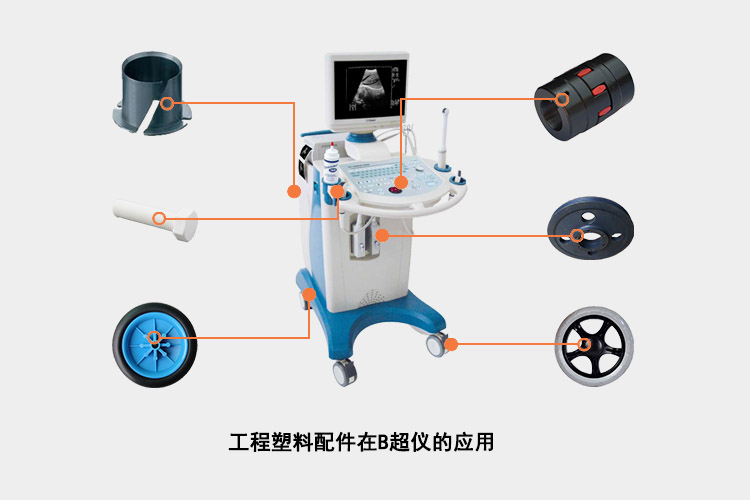
4. Special diagnostic equipment such as X-ray equipment, B-ultrasound equipment, and ultrasound equipment require the use of anti-radiation plastic materials;
5. Stability is also very important. In my country, medical equipment resources are relatively scarce, and the monomer has a high rate of action. This requires particularly high stability to be used normally under long-term high-load conditions;
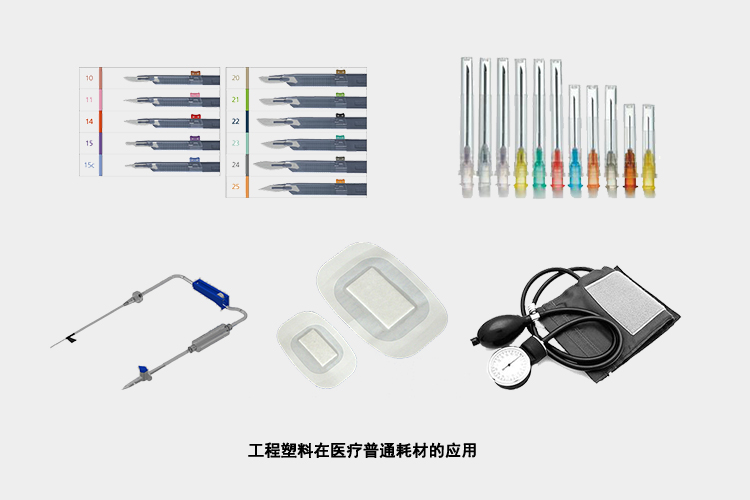
Application of engineering plastics in medical consumables
5. Application of engineering plastics in medical devices:
1. Application of general medical consumables
1. Introduction to Engineering Plastics:
Engineering plastics refer to plastics that can be used as engineering materials and to replace metal in the manufacture of machine parts. Engineering plastics have excellent comprehensive properties, high rigidity, low creep, high mechanical strength, good heat resistance, and good electrical insulation. They can be used for a long time in harsh chemical and physical environments and can replace metals as engineering structural materials. , But the price is more expensive and the output is small.
2. Performance characteristics:
1. Compared with general-purpose plastics, it has excellent heat and cold resistance, and has excellent mechanical properties in a wide temperature range, making it suitable for use as a structural material;
2. Good corrosion resistance, less environmental impact, and good durability;
3. Compared with metal materials, it is easy to process, has high production efficiency, and can simplify procedures and save costs;
4. It has good dimensional stability and electrical insulation;
5. Light weight, high specific strength, and outstanding anti-friction and wear resistance.
3. Special requirements for plastic raw materials for medical devices:
1. Since most monomers and their oligomeric compounds contain harmful components to the human body, there are quite strict restrictions on the corresponding residues on medical plastics;
2. It is inevitable to use materials containing metal ions such as reactors and metal catalysts in the polymerization process of plastics. According to the requirements of national medical plastics, there are clear regulations on the residues of metal ions such as lead, cadmium, copper, zinc, tin, and barium;
3. Medical plastics require high resin purity and narrow molecular weight distribution;
4. The additives in the plastic modification process need to use non-toxic additives to prevent and reduce the precipitation of the additives during long-term use, which affects the performance of the product and the therapeutic effect;
5. Internal medical plastics also have special functional requirements such as surface hydrophilicity, anticoagulant properties, and radiation sterilization resistance;
4. Requirements for plastics for medical equipment and appliances:
1. It is inevitable that medical equipment and appliances come into contact with some liquid medicines during use, because there are certain requirements for the acid and alkali resistance of plastics;
2. Most medical equipment is adjustable and rotating automation equipment, so there is a need for self-lubricating plastic;
3. The light usage rate in the working environment of the hospital is relatively high, and the weather resistance is also the rigid requirement of the equipment on the plastic;
4. Special diagnostic equipment such as X-ray equipment, B-ultrasound equipment, and ultrasound equipment require the use of anti-radiation plastic materials;
5. Stability is also very important. In my country, medical equipment resources are relatively scarce, and the monomer has a high rate of action. This requires particularly high stability to be used normally under long-term high-load conditions;
Application of engineering plastics in medical consumables
5. Application of engineering plastics in medical devices:
1. Application of general medical consumables
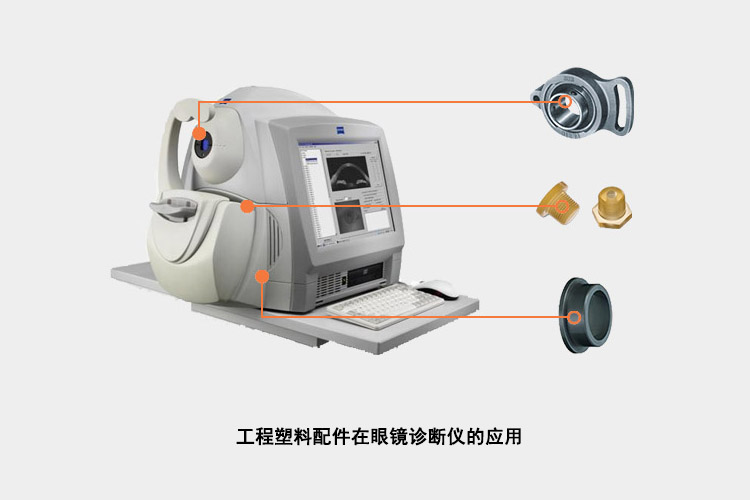
6. Application of engineering plastics in medical equipment:
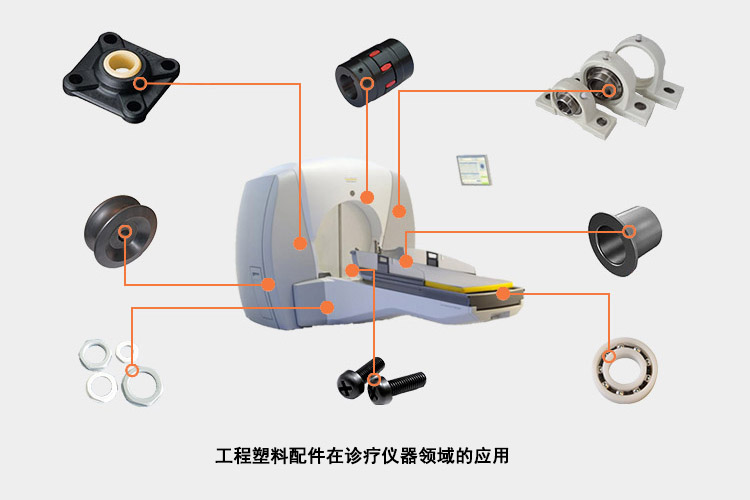
1. Application of equipment shell
Including: ordinary X-ray machine, fluoroscopy machine, digital subtraction angiography X-ray machine, medical magnetic resonance imaging equipment, automatic blood cell analyzer, biological microscope, high-speed refrigerated centrifuge, color Doppler ultrasound diagnostic apparatus, endoscopic imaging Workstation, gastric motility tester, central negative pressure suction equipment, etc.
2. Application of equipment transmission parts
Including: multifunctional rescue bed, mobile ultraviolet lamp, portable ventilator, portable blood oxygen saturation monitor, dynamic brain electric monitor, mobile negative pressure suction device, bed unit ozone disinfection machine, mobile negative pressure suction device, etc.
3. Application of internal component fastening system
Including: UV treatment device, excimer laser treatment device, ruby laser beauty device, neonatal hearing screening device, composite pulse magnetic treatment device, spine correction bed, fully automatic computer periscope, fast high temperature and high pressure steam sterilizer, etc.
Application of Engineering Plastics in B-ultrasound
Stop and look around during a doctor or hospital visit? Dozens of medical instruments and sanitary tools made of plastic become possible. From examination gloves to sterile syringes to IV tubes, plastics are everywhere in the medical field because they help protect us, prevent pollution and save lives.
Recent advances may lead to more healthcare innovations and help people all over the world. Here are some examples:
Medical engineering plastic rescue technology rescue
Plastic heart: A fully artificial heart made of plastic can prolong the lives of patients with heart failure while waiting for transplantation. The plastic heart replaces the ventricle and four heart valves, and adds years to the lives of loved ones.
Plastic foam: New uses of foamed polyurethane plastic may help stabilize trauma patients with severe internal injuries. The US military funded the development of ResQFoam, a spontaneously expanding foam that is injected into the abdomen to help stop internal bleeding. The foam expands inside the body cavity, exerting pressure on the wound and adapting it to the damaged tissue, greatly slowing down blood loss, thereby increasing the chance of survival.
Prevent pain
Medical engineering plastic painless plastic injection: Needle injection may be painful, but an easier way to deliver drugs is underway. One type currently under development is a tiny patch made of many plastic "microneedles" that dissolve after being inserted into the skin and release the drug at the same time. The other is MucoJet, a small plastic bulb and cylinder that is held against the inside of the cheek and squeezed to release the drug through the mucosal layer of the mouth and into the body.
Bacterial-resistant plastics: Millions of people unfortunately develop infections acquired in hospitals. These infections usually occur when a thin layer of bacteria settles on the exposed surfaces of medical devices. Researchers are studying non-stick polymer coatings to inhibit the formation of bacteria. Plastic can be used to make catheters or medical equipment to prevent preventable diseases.
Medical engineering plastic organs
3D printer body parts: we can 3-D print toys, tools, cars, etc. Although 3-D printed human body parts are still incomplete, they are closer than you think. Researchers are working hard to print various body parts, such as kidneys, skin, bones, cartilage, tissues, blood vessels, etc., and are made of various cell types, while using plastic to help maintain the structure of the parts. Today, 3-D printed plastic body part models are used for research and practice of complex and difficult surgery.
Self-healing plastics: Researchers are developing new materials of self-healing plastics and using them to develop artificial skin and muscles. Plastic skin mimics the flexibility and sensitivity of human skin and can make new prostheses, while plastic muscles can be used to help move prostheses, replace missing limbs, and even be used in advanced robots. And both can have their own abilities, just like human tissue.
If you think about it, all the plastic medical tools you think in the doctor's office are revolutionary. Plastics will continue to help drive the healthcare innovations we can only dream of today.
The following is a brief introduction to the properties of several commonly used medical plastics as follows:
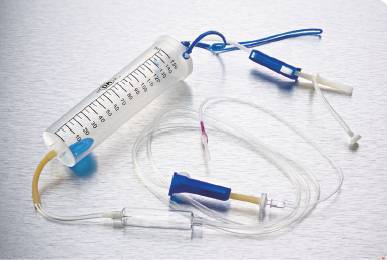
1. Polyvinyl chloride (PVC):
Hard PVC does not contain or contains a small amount of plasticizer, has good tensile, flexural, compression and impact resistance, and can be used as a structural material alone. Soft PVC contains more plasticizers, its flexibility, elongation at break, and cold resistance increase, but its brittleness, hardness, and tensile strength decrease. The density of pure PVC is 1.4g/cm3, and the density of PVC plastic parts added with plasticizers and fillers is generally in the range of 1.15 ~ 20g/cm3. Mainly because of the low cost of the resin, wide application range, and easy processing. Medical PVC products include: hemodialysis tubing, breathing mask, oxygen tube, etc.
2. Polyethylene (PE):
PE mainly includes low-density polyethylene (LDPE), high-density polyethylene (HDPE), and ultra-high molecular weight polyethylene (UHDPE). HDPE has fewer branches on the polymer chain, higher relative molecular weight, crystallinity and density, higher hardness and strength, poor opacity, and higher melting point. It is often used in injection molded parts.
LDPE has many branches, so the relative molecular weight is small, the crystallinity and density are low, it has good flexibility, impact resistance and transparency. It is often used in blown film and is an alternative to the widely used PVC. . It is also possible to mix HDPE and LDPE according to performance requirements. UHDPE has high impact strength, low friction, stress crack resistance and good energy absorption characteristics, making it an ideal material for artificial hip, knee and shoulder connectors.
3. Polypropylene (PP):
Polypropylene is colorless, odorless and non-toxic. It looks like polyethylene, but it is more transparent and lighter than polyethylene. PP is a kind of thermoplastic with excellent performance. It has the advantages of small specific gravity (0.9g/cm3), non-toxicity, easy processing, impact resistance, flexural resistance and so on. It has a wide range of applications in daily life, including woven bags, films, turnover boxes, wire shielding materials, toys, car bumpers, fibers, washing machines, etc.
Medical PP has higher transparency, better barrier properties and radiation resistance, making it widely used in medical equipment and packaging industries. Non-PVC material with PP as the main body is a substitute for the widely used PVC material.
PP is a semi-crystalline material with high melting point, good heat resistance, and can be sterilized at temperatures above 100°C. The yield strength, tensile strength, compressive strength, hardness and elasticity are higher than those of polyethylene (PE).
4. Polystyrene (PS) and K resin:
PS is the third largest plastic product after polyvinyl chloride and polyethylene. It is usually processed and applied as a single-component plastic. Its main characteristics are light weight, transparency, easy dyeing, and good molding and processing properties, so it is widely used in Japan. Use plastics, electrical parts, optical instruments and cultural and educational supplies. The main uses in daily life include cups, lids, bottles, cosmetic packaging, hangers, toys, PVC substitute products, food packaging and medical packaging supplies.
5. Acrylonitrile-butadiene-styrene copolymer (ABS):
ABS has certain rigidity, hardness, impact resistance and chemical resistance, radiation resistance and resistance to ethylene oxide disinfection. The medical application of ABS is mainly used as surgical tools, roller clamps, plastic needles, tool boxes, diagnostic devices and hearing aid housings, especially the housings of some large-scale medical equipment.
6. Polycarbonate (PC):
The typical characteristics of PC are toughness, strength, rigidity and heat-resistant steam sterilization. These characteristics make PC a priority choice for blood dialysis filters, surgical tool handles and oxygen tanks (when in surgical heart surgery, this instrument can remove blood Carbon dioxide, increase oxygen). The medical applications of PC also include needle-free injection systems, perfusion instruments, blood centrifuge bowls and pistons. Taking advantage of its high transparency, the usual myopia glasses are made of PC.
7. Polytetrafluoroethylene (PTFE):
PTFE resin is white powder, waxy in appearance, smooth and non-sticky. PTFE has excellent performance, which is not comparable to ordinary thermoplastics, so it is known as the "Plastic King". Its friction coefficient is the lowest among plastics, and it has good biocompatibility. It can be made into artificial blood vessels and other devices directly implanted in the human body.
Content source: network
Disclaimer: The content is reproduced online, and the copyright belongs to the original author. However, due to the large number of reprints, the true original author cannot be confirmed, so only the source of the reprint is indicated. If the videos, pictures, and texts used in this article involve copyright issues, please inform as soon as possible. We will delete the content immediately after confirming the copyright based on the supporting materials you provide!