What is plastic
The concept of plastic
1. Plastic is a kind of artificial high molecular organic matter (epoxy resin) with plasticity.
2. Plastic is a kind of artificial high molecular organic matter (epoxy resin) with plasticity.
Plastic is a man-made material with organic resin as the main component, with or without other complementary materials (modifiers). It can usually be plasticized into components with a certain shape under high temperature and pressure.
3. Plasticity refers to the property that, like clay, it changes shape when speed changes, and does not return to normal after the external force is removed. Elasticity refers to the property that it changes shape when a certain degree of force is added, but returns to normal when the applied force is removed. This kind of property is called elasticity (for example: plastic), and objects with elasticity are called elastomeric materials (such as elastic ropes); plastics are made into various shapes through this kind of plasticity generated when heated.

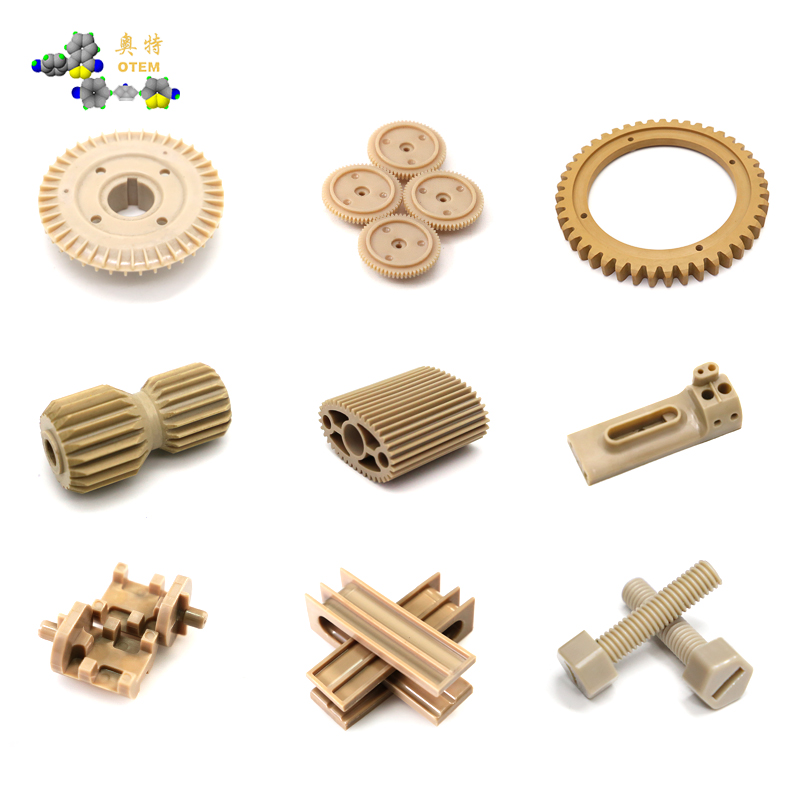
Guangzhou OTEM Engineering Plastics Co., Ltd., our company is committed to excellent performance
plastic and engineering plastic injection molding, PEEK injection molding, PEEK plastic parts, PFA injection molding, PPS injection molding, PVDF injection molding, PSU injection molding and injection mold manufacturing.
The origin of plastic
Plastics are high molecular organic substances (polymers) that are formed by the aggregation of low molecular organic substances (such as butadiene, PE, butadiene, styrene, vinyl alcohol, etc.) under certain conditions. The molecules that make up plastics have molecular weights above 10,000, so plastics are medium molecular chemical substances (polymers). Generally, plastic molecules contain carbon (C) molecules and hydrogen (H) molecules, and some plastic molecular systems contain a small amount of oxygen (O) and sulfur (S) molecules. The most basic material of plastics is low molecular carbon and hydrogen chemical substances, which are artificial epoxy resins extracted and synthesized from crude oil, natural gas or coal cracking products.
The development of plastics
Development and production time of different plastics:
■1920-1933: Polyethylene (PS), Polyvinyl Chloride (PVC), High-Pressure Polyethylene (PE), Butadiene-Vinyl Acetate Polymer (EVA), Polypropylene (PP)
■1935: Acrylonitrile-butadiene-butadiene polymer (ABS)
■1939: Polyethylene terephthalate (ABS)
■1949: Acrylic resin (Nylon)
■1950: Polymethyl methacrylate (Acrylic)
■1956: Polyester chips (POM)
1958: Polycarbonate (PC)
■1964: Polyoxyphenylene oxide (PPO)
1965: Polysulfone (PSF)
1975: Polybutylene terephthalate (PBT)
1985: Liquid Crystal Display Plastic (LCP)
■1994: Modified material is injection molding grade PET (PETG)
■1995: Super elastic polyester chips (TPOM)
■1996: Fully transparent rigid polyvinyl chloride
Since the 1960s, the use and processing of plastics has developed by leaps and bounds.
Types of Plastics
1. Classification by application scope of plastics
Generally divided into general-purpose plastics and engineering plastics:
◆General-purpose plastics can only be used as general non-structural materials. They have large production, relatively low prices, and general properties. They are generally used to make daily necessities. (Such as: PE, PP, PVC, PS, PMMA, EVA, etc.)
◆Engineering plastics refer to those with strong physical properties, heat resistance and corrosion resistance, which can be used as structural raw materials, and have excellent overall properties (including physical properties, electrical properties, heat resistance, chemical resistance, etc.), and can maintain these properties well over a wide temperature range and for a long time, and can be used in long-term applications under thermal shock and harsh organic chemical and material environments. The seven recognized engineering plastics are: ABS, PC, POM, PA, PET, PBT, PPO, etc. The total output of engineering plastics is relatively small and the price is relatively expensive. In addition, there are also functional plastics (such as: LCP, artificial organs, etc.), nanotechnology plastics, dissolving plastics, etc.
2. Classification by crystal form of plastics
Generally divided into crystalline plastics and amorphous plastics
Crystalline plastics refer to plastics whose molecules can form certain geometric shapes under appropriate conditions (such as PE, PP, PA, POM, PET, PBT, etc.), most of which belong to a certain crystalline state. Amorphous plastics refer to plastics whose molecules are arranged in a disordered state instead of a molecular structure (such as ABS, MBS, PC, PVC, PS, PMMA, EVA, AS, etc.). The mechanical properties of amorphous plastics in different directions are the same (anisotropy).
3. Classification according to the basic behaviors they exhibit when exposed to heat
Generally divided into thermosetting plastics and thermosetting plastics
Thermosetting plastics refer to plastics that can be continuously softened by heating and hardened by cooling within a specific temperature range (such as ABS, PP, POM, PC, PS, PVC, PA, PMMA, etc.), and can be recycled and reused. Thermosetting plastics refer to plastics that become infusible after being heated, and are no longer plastic when heated again and cannot be recycled and reused (such as urea-formaldehyde resin, epoxy resin glue, amino resin, polyurethane, expanded polystyrene, etc.).
4. Classification by the transmittance of plastics
Generally divided into fully transparent plastic, transparent plastic and transparent plastic.
Plastics with a transmittance of more than 88% are called fully transparent plastics (such as PMMA, PS, PC, Z-polyester, etc.). Common transparent plastics include PP, PVC, PE, AS, PET, MBS, PSF, etc. Opaque plastics mainly include POM, PA, ABS, HIPS, PPO, etc.
5. Classification by plastic hardness
Generally divided into hard plastics, semi-hard plastics, and soft plastics
◆ Common hard plastics include: ABS, POM, PS, PMMA, PC, PET, PBT, PPO, etc.;
◆Semi-rigid plastics include: PP, PE, PA, PVC, etc.;
Soft plastics include: soft PVC, K glue (BS), TPE, TPR, EVA, TPU, etc.
6. Classification by chemical structure of plastics
A. Isoprene rubber (such as LDPE, MDPE, HDPE, LLDPE, UHMWPE, PP, etc.)
B. Polyethylene (such as: PS, AS, BS, ABS, MBS, HIPS, etc.)
C. Acrylic resins (such as PA6, PA66, PA610, PA1010, etc.)
D. Polyethers (such as PC, POM, PSF, PPO, etc.)
E. Polyester (such as PBT, PET, etc.)
F. Acrylates (such as PMMA)
Guangzhou OTEM Engineering Plastics Co., Ltd.Our company is committed to high-performance plastics and engineering plastics injection molding.PEEK Injection Molding, PEEK plastic parts, PFA injection molding, PPS injection molding, PVDF injection molding, PSU injection molding and injection mold manufacturing.
Guangzhou OTEM Engineering Plastics Co., Ltd., your technical expertise plastic? Consultant!
About Us Product Infor Application Service Human Resources Contact us
———— ———— ———— ———— ———— ———— ————
Company Profile Hign-Perfomance E?egineering? news Industry Application Technical Q&A Humanistic care Contact information
C?ompany culture E?egineering Plastic Applications Humanities Policy Online message
Enterprise Honor Fluoroplastic Job Recruitment